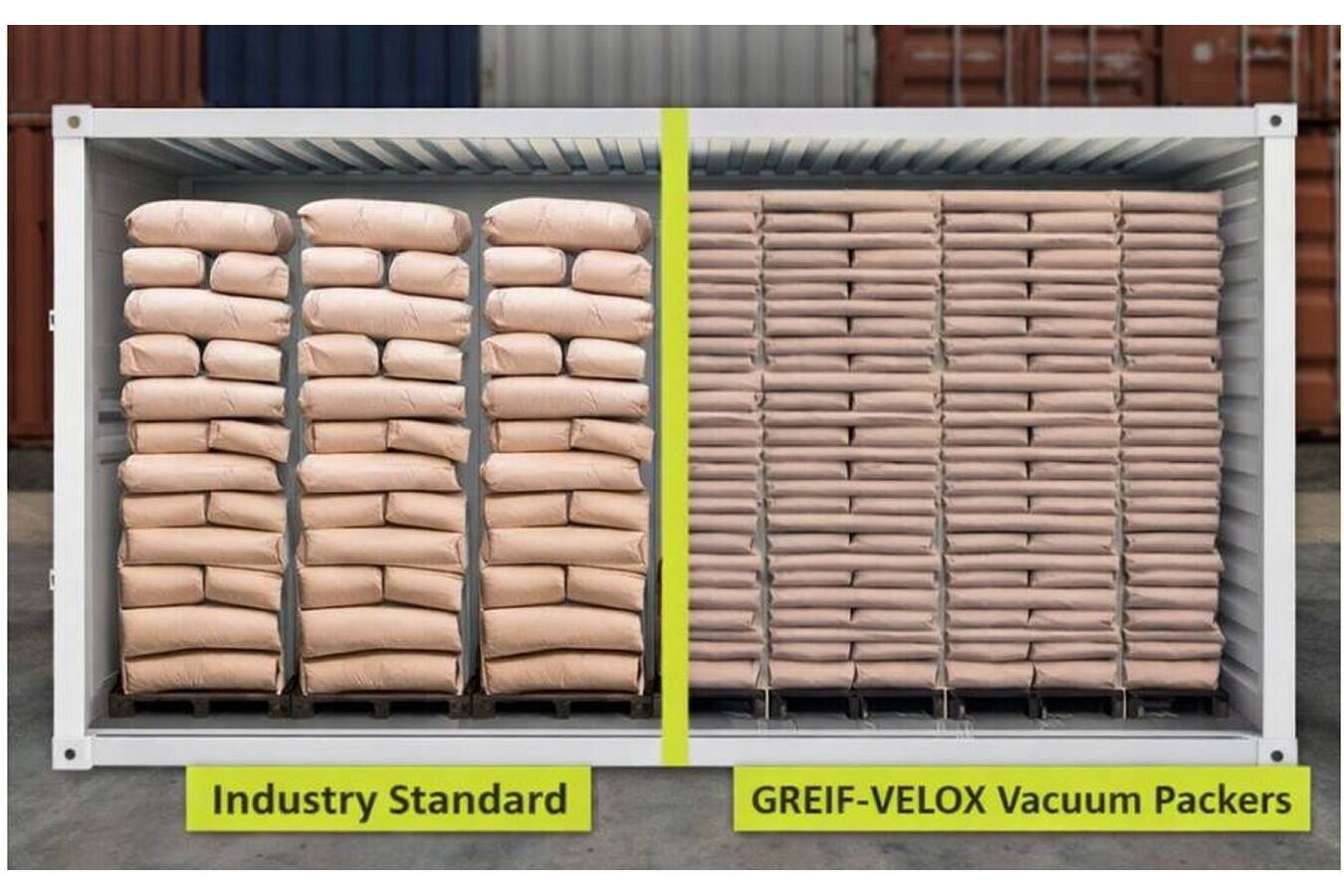
During filling, the material contains a high proportion of air. If this air is not specifically removed, it significantly reduces the effective product quantity per bag and per transport unit.
The Influence of Bulk Density on Container Utilization
A standard 20-foot container typically holds approximately: 10,080 kg per container when pigments are packed using conventional filling methods.
By applying vacuum-assisted compaction during the filling process, container loads of up to 27,600 kg per container can be achieved.
This corresponds to an increase of: +17,520 kg of product per container.
The product, container size and mode of transport remain unchanged.
The difference lies solely in the reduction of the air content within the bag.
Economic Considerations
Assuming a product value of €200 per kilogram, the calculation is as follows: 17,520 kg × €200/kg = €3,504,000 additional product value per container. This example illustrates the significant impact that compaction can have on the transported product value per shipment unit. In addition to the product value itself, the specific transport costs per tonne are also substantially reduced.
Impact on Logistics and Sustainability
- Reduced logistics costs per transported tonne (in practice, reductions of up to 75% are achievable)
- Lower CO₂ emissions per unit of material transported
- Fewer container movements for the same shipment volume
- More efficient warehousing and handling processes
- Improved stacking and palletizing performance due to a more compact bag geometry
Especially in global supply chains with a high proportion of sea freight, packaging density becomes a relevant economic factor.
Technical Approach
The vacuum-based VeloVac filling system operates with controlled air extraction during the filling process. The air contained in the powder is removed during filling and prior to bag sealing.
The result is an increased bulk density within the package while maintaining bag stability and shape integrity. The process is particularly suitable for:
- Pigments
- Carbon black
- Silica
- Pesticides
- Cellulose fibres
- Specialty additives
- and, in general, products with low bulk density and high air content
Conclusion
Packaging influences not only product protection and handling, but increasingly also economic performance and sustainability throughout the supply chain.
The targeted removal of air during the filling process can significantly improve transport unit utilization and thereby make a direct contribution to overall efficiency.