Recycling has changed dramatically over the past decade. The importance of material recycling in today’s world has increased significantly. Technologies and processes have become increasingly complex and advanced over time. Whether waste wood recycling, LVP (lightweight packaging) recycling, recovered paper recycling, metal recycling, or even the recycling of lithium-ion batteries and rechargeable battery packs—the depth and sophistication of the recycling process continue to grow.
In recent years, however, the industry has also had to gain extensive experience with devastating fire incidents. The causes of these fires are diverse, but contaminants in the material stream—especially lithium-ion batteries and rechargeable battery packs—have often proven to be the leading cause. Despite fire protection measures that are sometimes already in place, fires in the recycling industry are difficult to control. Without adequate fire protection, fires pose an existential threat. As a consequence of many severe fire losses, the industry has become barely insurable.
Why traditional detectors are often too late
Conventional smoke, heat, or flame detectors usually require direct contact with smoke, hot air, or visible flames in order to detect a fire. A heat detector, for example, only triggers once a sufficient “heat buildup” forms beneath it. In typical areas of the recycling industry, this is often problematic:
- Outdoor storage and semi-open areas: Airflow disperses smoke/heat; alarms are delayed or may not occur at all.
- Very high buildings/halls: Smoke and heat often reach ceiling-mounted detectors only at a late stage.
- Large areas: Installation is complex, and performance is not always reliable.
The powerful duo: detection + fast, precise suppression
Linking early infrared detection with a suitable fire suppression system is particularly effective. Depending on the requirements, cameras can be used in certified applications (e.g., VdS or DIN EN 54-10) and connected to a fire detection system (FDS) as special fire detectors.
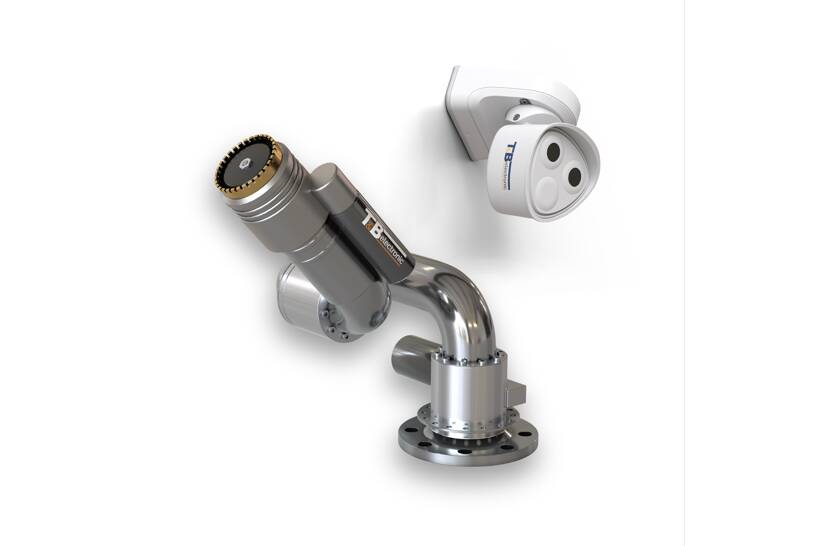
In the event of an incident, the cameras transmit hotspot coordinates to fire monitors, which then carry out suppression fully automatically and with pinpoint accuracy (manual operation is also possible). This creates a fire protection concept that detects early and suppresses quickly—robust, scalable, and often requiring less installation effort than traditional solutions.