
|
Product news |
Published: 29-09-2022 Print date: 05.09.2026 |
|
|
Product news |
Published: 29-09-2022 Print date: 05.09.2026 |
Aluminium processing in confined spacesHigh grade purity despite impurities: Innovative complete plant with three operating modes safely filters recycled aluminium from difficult input material
According to statistics from the German industrial credit bank AG (IKB), global production of primary aluminium increased by 3.1 per cent to 65.3 million tonnes in 2020. In addition, around 11.8 million tonnes of the light metal were recycled. Especially in the case aluminium scrap, grade purity plays a major role for subsequent processability. In order to be able to sell the purest material possible on to aluminium processing companies, and thus most profitably, an Austrian company needed new equipment for crushing and separating different input materials. The challenge: The aluminium dust and aluminium alloys with magnesium admixtures produced during the crushing process are highly flammable, so there is an acute risk of fire and explosion in the plant. To ensure the safety of the machines and the employees at all times, the company cooperated with Erdwich Zerkleinerungs-Systeme GmbH. The experienced company from Igling in Bavaria implements a special plant concept that not only enables an almost sort-pure separation of the materials, but also allows three different operating modes for the most flexible processing possible.
Metals are currently among the most sought-after raw materials worldwide: the price of aluminium alone has risen from around USD 1,620/t to more than USD 2,550/t within the year from the beginning of July 2020. The advantage of aluminium is that the metal can be melted down almost as often as desired and processed into various products. Moreover, only 5 per cent of the energy required for the production of primary aluminium must be used for the recycling of aluminium scrap. But in order for processing companies such as car manufacturers or producers of electronic goods and packaging materials to buy the raw material at the required prices, the recycling companies have to supply material that is as pure as possible so that it can be melted down and processed further without delay.
However, as the metal processing companies increasingly demanded pure, unmixed recycling materials, the management decided in 2019 to optimise the entire plant concept with regard to the processing of aluminium scrap. For the implementation, the company again commissioned the experts for shredding systems from Erdwich due to their good experience with the twin-shaft shredder. This time, however, a single machine was not enough: in order to be able to react as flexibly as possible to the variety of input materials, the Igling based company planned and implemented a complete plant concept into which the existing twin-shaft shredder was integrated. The shredding plant was supplemented by a hammer mill also developed by Erdwich. Several challenges had to be resolved simultaneously. ”For one thing, the space available for the plant was limited to a very narrow, half-open hall, which required planning with centimetre precision and foresight,” explained Harald Erdwich, Managing Director of Erdwich Zerkleinerungs-Systeme GmbH. ”On the other hand, the input material consists in part of undefinable components such as non-metallic impurities or even solid iron parts, which made sorting difficult. Therefore, it was necessary to implement several processes and the corresponding equipment to separate different materials and alloys.”
But the input fractions are not always composed in the same way. In order to be able to react more flexibly, Erdwich therefore implemented a hitherto unique concept: three different modes can be set for the efficient processing of the material. ”In mode A, the aluminium scrap is fed directly into the RM1350 pre-shredder by means of a gripper or stacker and then re-shredded by means of our HA800 hammer mill,” Erdwich reports. ”The mixed fractions are separated using various sorting techniques and then discharged into containers provided by the customer.” Mode B enables the faster processing of pure aluminium scrap. After shredding in the twin-shaft shredder, a separation of FE and V2A material is carried out by means of a double magnetic stage; the discharge takes place by means of a swivelling conveyer belt into the containers provided.
After crushing with the hammer mill, the output fractions are only about 70 mm in size, so that the material can be easily transported and subsequently melted down again. Any changes in the composition of the input material are no problem, because the three different operating modes and the innovative sorting techniques also allow other types of scrap to be processed carefully. There is no need to worry about clogging or machine breakage. With the system completely planned and realised by Erdwich, the company is optimally equipped for the future and can easily and quickly adapt to new developments in scrap processing without having to put up with lengthy repairs and downtimes. 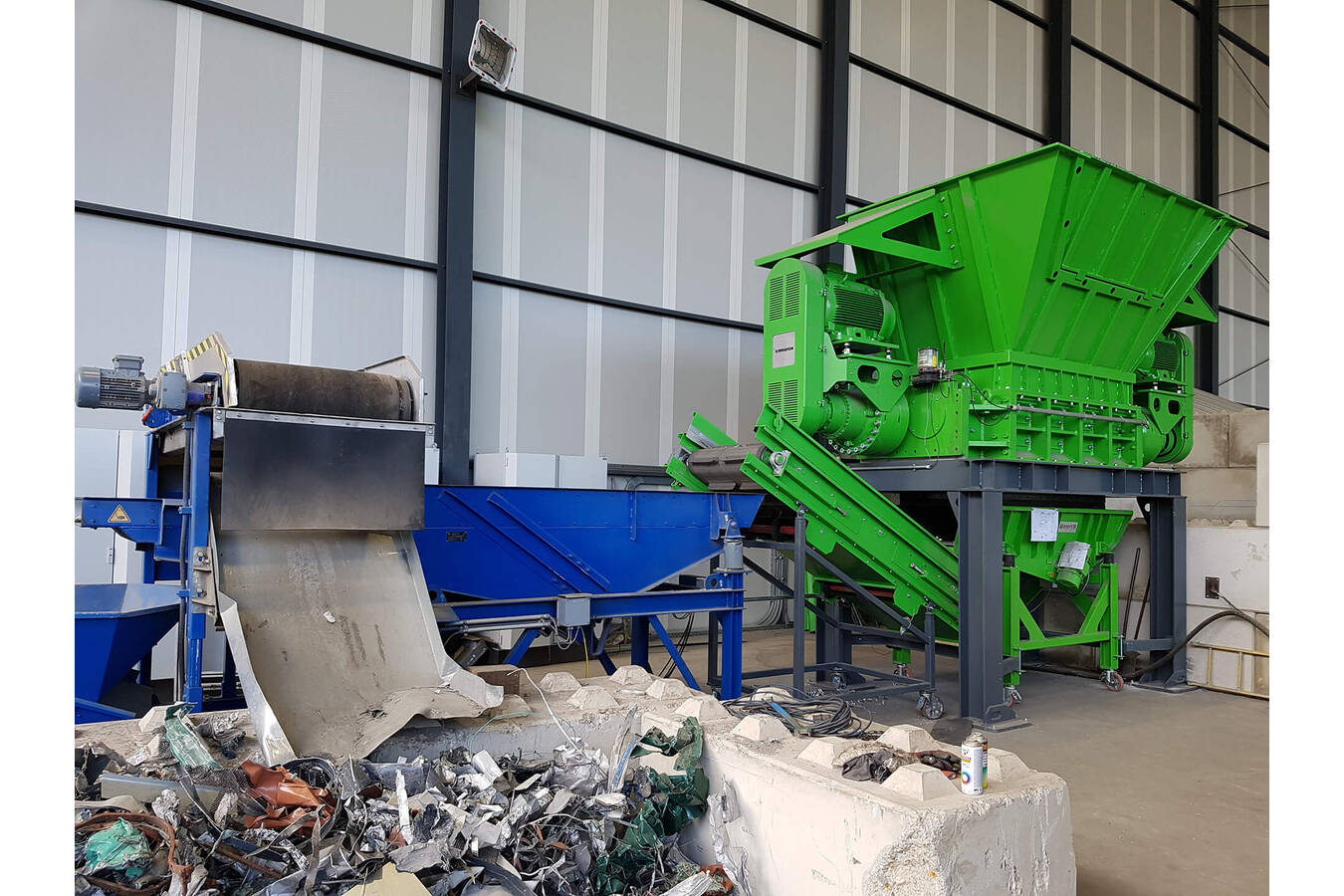
In order to separate the different input fractions from each other, various sorting processes are integrated into the overall plant. In mode A, the aluminium scrap is fed directly into the pre-shredder, the RM1350, by means of a gripper or stacker and the
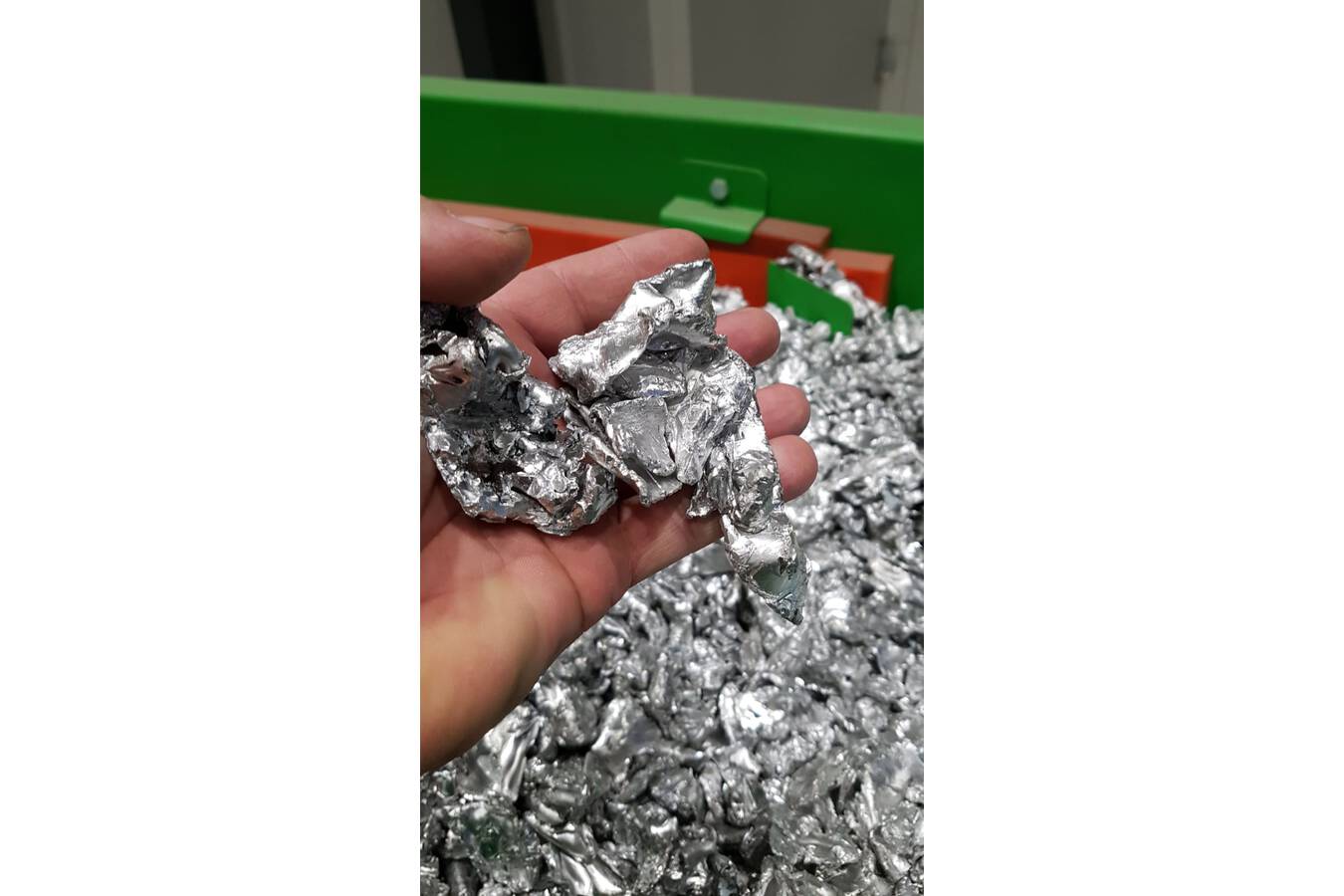
After crushing with the hammer mill, the output fractions are only about 70 mm in size, so that the material can be easily transported and subsequently melted down again.
|