Old tyres become new raw materials
Pyrum plant sets standards in industry 4.0. In Dillingen, in the heart of the Saarland steel district, PYRUM Innovations turns old tyres into new raw materials
Oil, recovered carbon black and gas are generated in the process and fed back into industry. This is the result of 15 years of hard work, a green entrepreneurial spirit and Industry 4.0, in order to ensure stable control of all processes. VEGA sensors are also a vital component, as they perform reliable monitoring of all levels and pressures.
In the beginning was the idea. Someone had obviously taken a close look and not only realised that there was a huge problem, but also set out to find a solution.
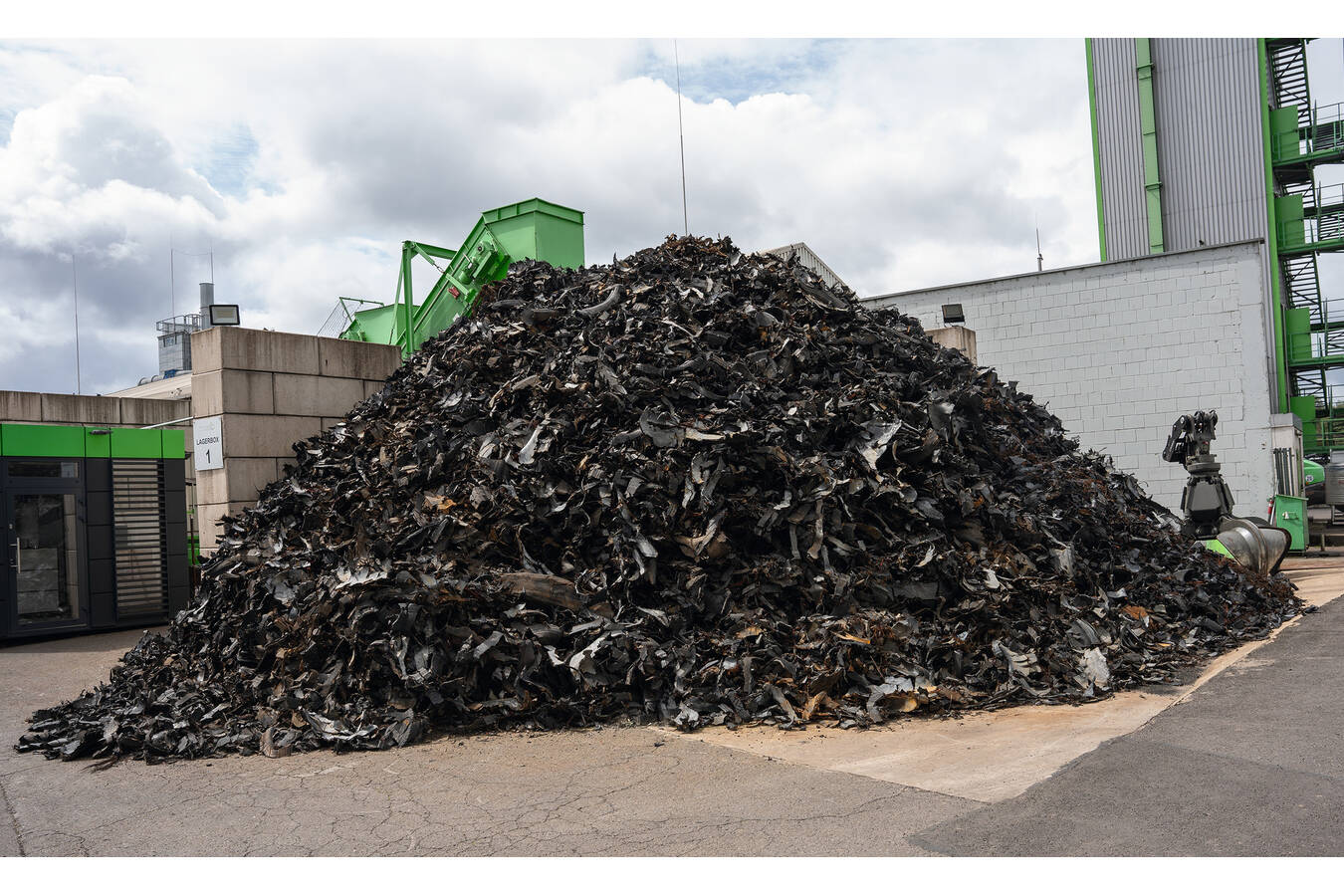
The problem came to a head around 2008, when the sheer volume of scrap tyres became unmanageable and no sensible use for them could be found. Piled high, they sometimes caught the eye in temporary storage in tyre workshops, but time and again one could see them piled up in the driveways of farms or lying abandoned on the roadside. Anyone who has a car probably wonders from time to time what happens to the tyres they have just replaced, as over three million tonnes of discarded rubber material are produced every year in Europe alone. The final destination in almost all cases: Incineration and then the ash is used at the cement works.
Making rubber greener
Having recognized the problem, “four friends” were having a heated discussion together under a “3 x 3 meter gazebo.” According to PYRUM AG, this was the initial spark for the founding of the company, as the four not only brought with them expertise from a wide range of disciplines, but also a suitable unused industrial site near Dillingen. The location would subsequently prove to be perfect: Here, in the middle of Saarland’s ’Rust Belt’, people are familiar with heavy industry and know better than anyone else that industries only have a future if they can adapt to today’s requirements. Dillinger Hütte, which belongs to Saarstahl, is currently preparing to tackle the mammoth project “Transformation to Green Steel.” It has long been thought that what steel can do, “rubber” can too.
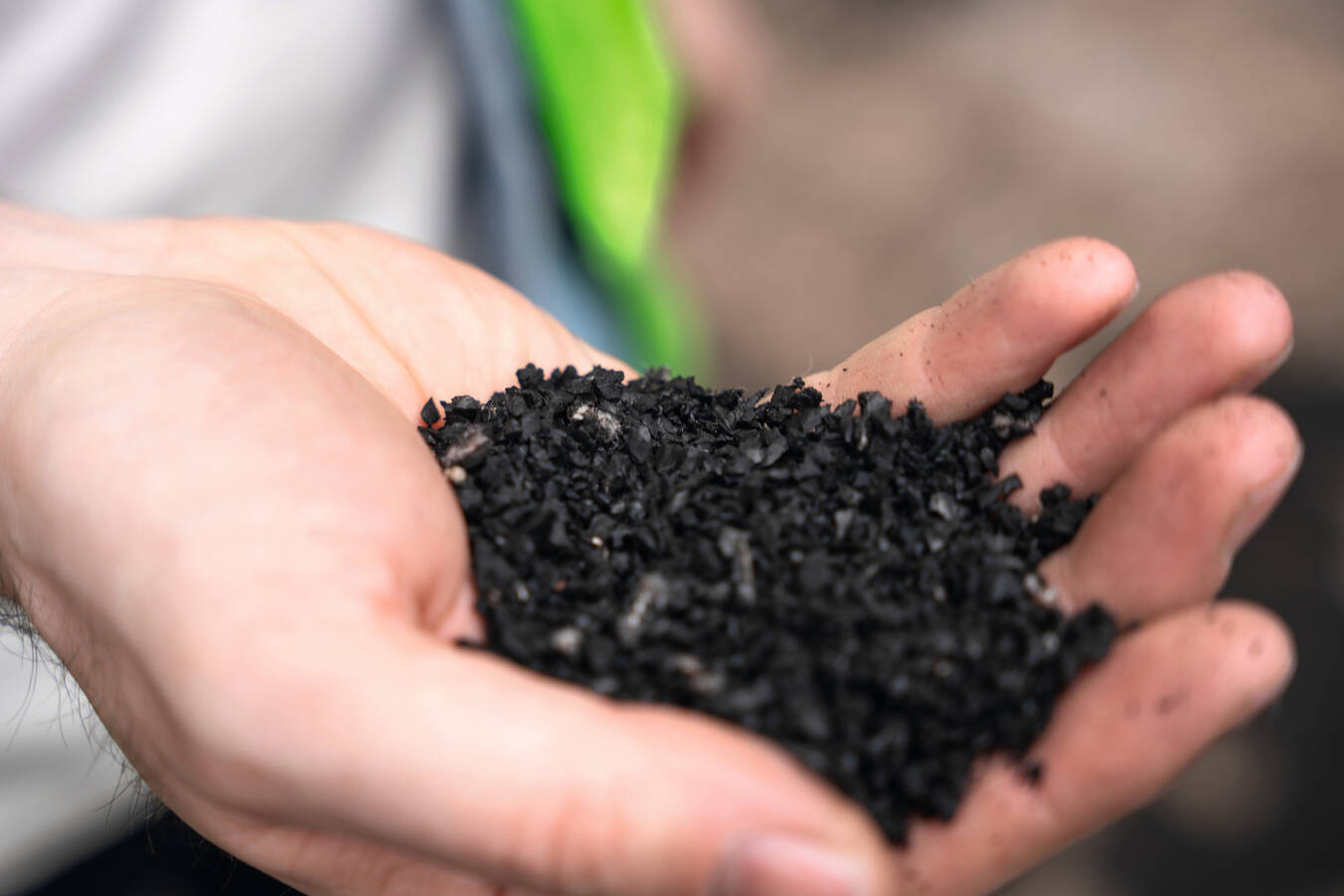
It was the first step in a long journey. In 2023, the second of three pyrolysis reactors went into 24/7 operation on an industrial scale. A special mixture of shredded used tyres is now pyrolysed there anaerobically. In an atmosphere completely lacking in oxygen, the granulate is broken down into coke (48%), gas (20%) and oil (32%) at high temperatures. Reactor 2 is now converting 5,000 tonnes of rubber granulate every year, which is the equivalent of around 7,500 tonnes of tyres. The coke is the most valuable part: The resulting quality depends on the mixture fed in as well as the process parameters and the stability of the process. Customers for the products have existed for a long time already.
15 years of development on a clean slate
It took PYRUM almost exactly 15 years before it became a global technology supplier. Countless investments were made. In 2021, fresh capital was added through an IPO; this was followed by joint ventures with leading tyre manufacturers and a global chemical company and finally, in 2020, the decision to expand by threefold the production capacity at the Dillingen site. A major challenge was figuring out how to control the numerous plant processes and keep them stable. Many tonnes of raw material are channelled through a reactor, travelling 5 floors down a 25-metre-high tower. The whole trick here is to maintain exact dosages and pressure and temperature levels precisely so that no hard clumps of material form and no pipes become clogged with buildup. It’s a gigantic, complex undertaking, and one that other companies have tried and failed at.
Maintenance without specialised personnel
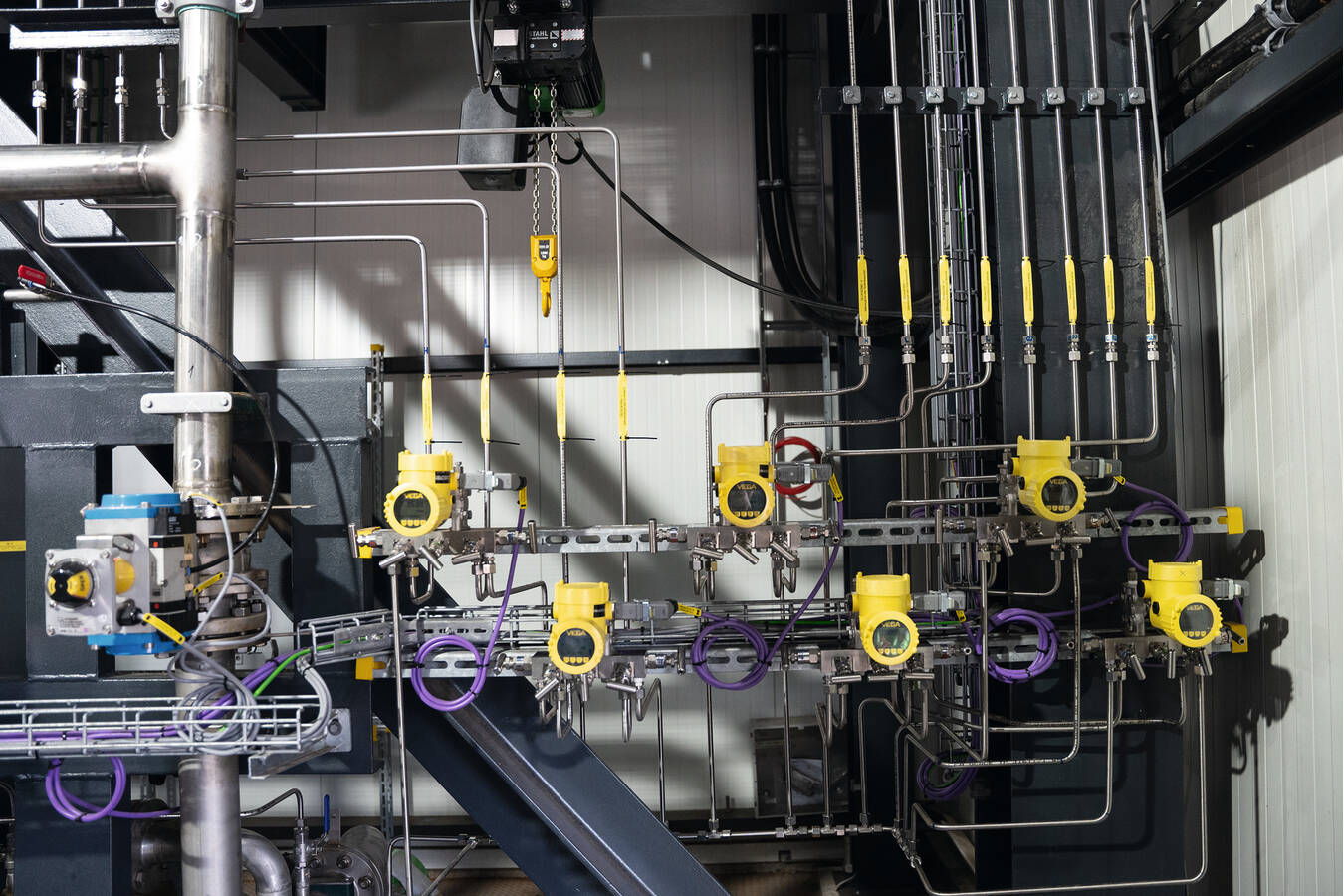
As a technology supplier, PYRUM wants to establish its plant technology and business model worldwide. Anything that’s supposed to function as a master plan anywhere in the world must be fully developed: i.e. thoroughly tested and prepared for every eventuality. State-of-the-art process technology in the company’s reactor tower ensures intelligent communication between all components involved, with the required stability and reliability. This technology is the responsibility of senior ICA engineers Christian Maas and Meike Jungmann, who have been on board since 2021 and 2017. In their case, management means: develop from the ground up: tinker, test, discard, rethink, so that “we get a reliable process and consistent results in continuous operation,” says Maas. “We learned a lot the hard way, did an incredible amount of testing, made a lot of mistakes, but just kept trying.” His professional experience in the energy industry stood him in good stead. One of the things you learn here is not to cut corners. For that reason, “no compromises” is his motto when it comes to the many level and pressure sensors in use. “If the applications are not monitored 100 percent reliably, even the best processes won’t help us.” He has learned that mistakes are expensive, which is why he relies on the best sensor quality available. “It definitely pays off.” Maas is referring to VEGA pressure sensors, which are equipped with “Harting connectors” and work together with the control technology to ensure safety through maximum simplicity. Maintenance and replacement should be possible without the need for specialised in-house personnel: “Plug in the sensor, then parameterise it via the control technology, done.”
Digitalisation on a whole new level
The entire control room at the Dillinger plant still looks brand new in autumn 2023. At their desks, stylishly equipped with web-based process control technology, a team of four technicians monitor all of the plant’s processes and procedures. In a 5-shift schedule, a single work station is sufficient for each reactor line. “We were able to design our digitalisation model on a clean slate, i.e. without having to take into account legacy infrastructure. “That’s a blessing and a curse at the same time,” explains Maas. There was great opportunity in this freedom, because the ICA engineers didn’t have to make any technical compromises when it came to digitalisation. Commissioning and operator training were carried out in advance virtually, using digital models of the system and the measurement technology. This involved very little risk and helped avoid follow-up expenditure. However, there was the cost of having to design everything completely from scratch, without any precedents.
For the future, the ICA engineers are already working on a demo plant in which future digitalisation concepts can be modelled and technologies such as MTP (Module Type Package) or Ethernet-APL (Advanced Physical Layer as a communication platform) is tested thoroughly in advance. Maas is convinced that “with its high transmission rate, APL opens up new opportunities for us to utilise additional data from the field.” The APL abbreviation attached to Ethernet communication describes the physical layer on which the complex process data is transmitted at high speeds of up to 10 Mbit/s. Thanks to the demo system, it becomes clear beforehand exactly how the processes will run in demanding environments, for example in Ex-hazardous areas or over long distances: In future, the data will not only be uploaded to the control system at lightning speed by VEGA sensors, but will also be easily retrieved from there when needed. This will make it possible to recognise errors much more quickly, and even completely avoid them in good time.
The core element on level 3
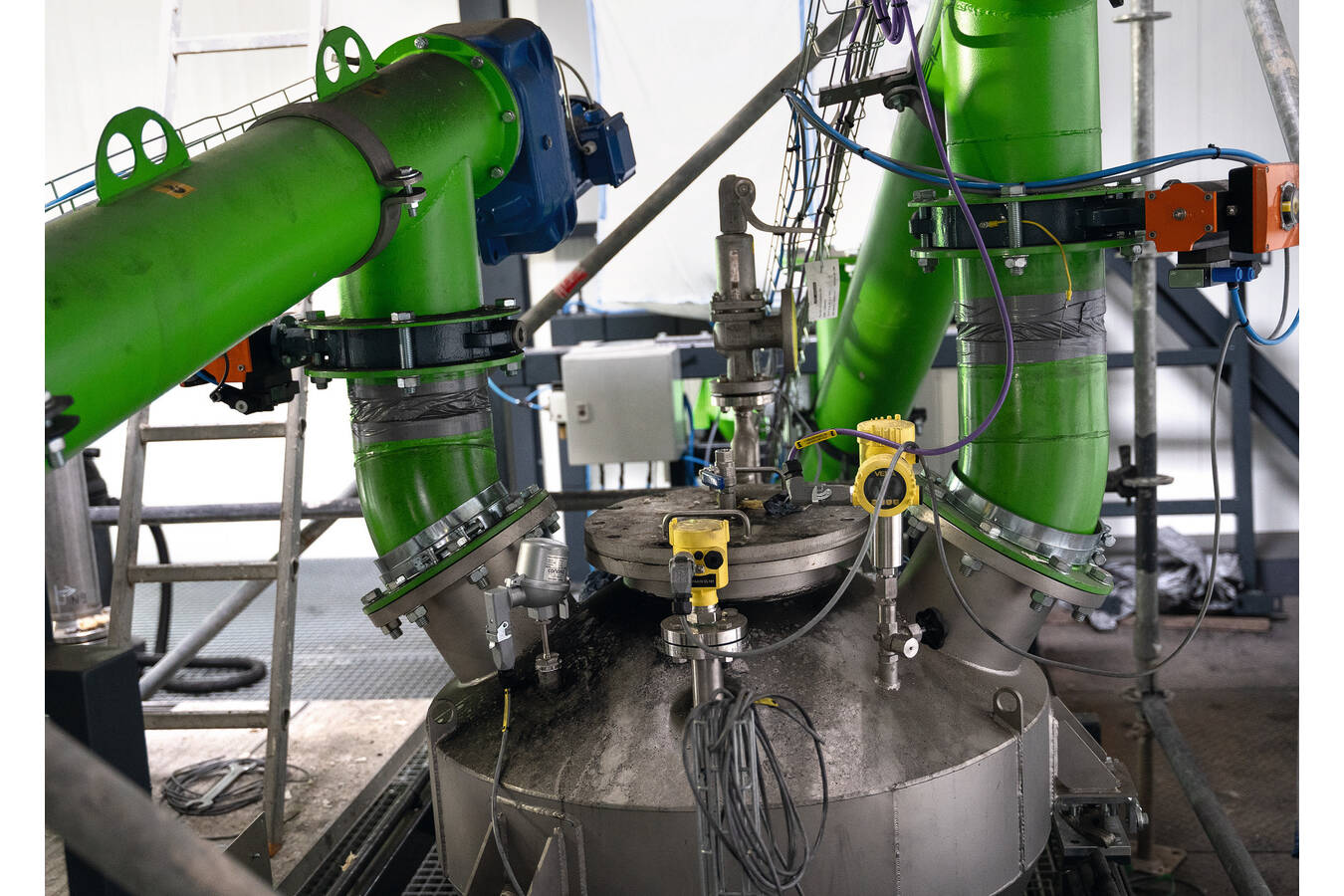
The very centre of the processing system, on which PYRUM holds several international patents, consists of the reactor on level 3. Only here, integrated among of 170 control loops, are VEGA measuring instruments monitoring and diagnosing to ensure that the reactions pass through their process stages within the precisely defined limit levels and pressure spectra. One measuring point that really catches the eye here is a VEGABAR 83 pressure transmitter, responsible for recording the gas pressure inside the reactor. The condensation stages and pressures within the condensate circuits must also be precisely monitored and regulated. If deviations in the process occur, clean separation of the valuable oil from unwanted substances is no longer guaranteed, and the product becomes contaminated. “The measurement technology must deliver reliable results even under difficult process conditions,” says Maas.
Sensor potential doubled
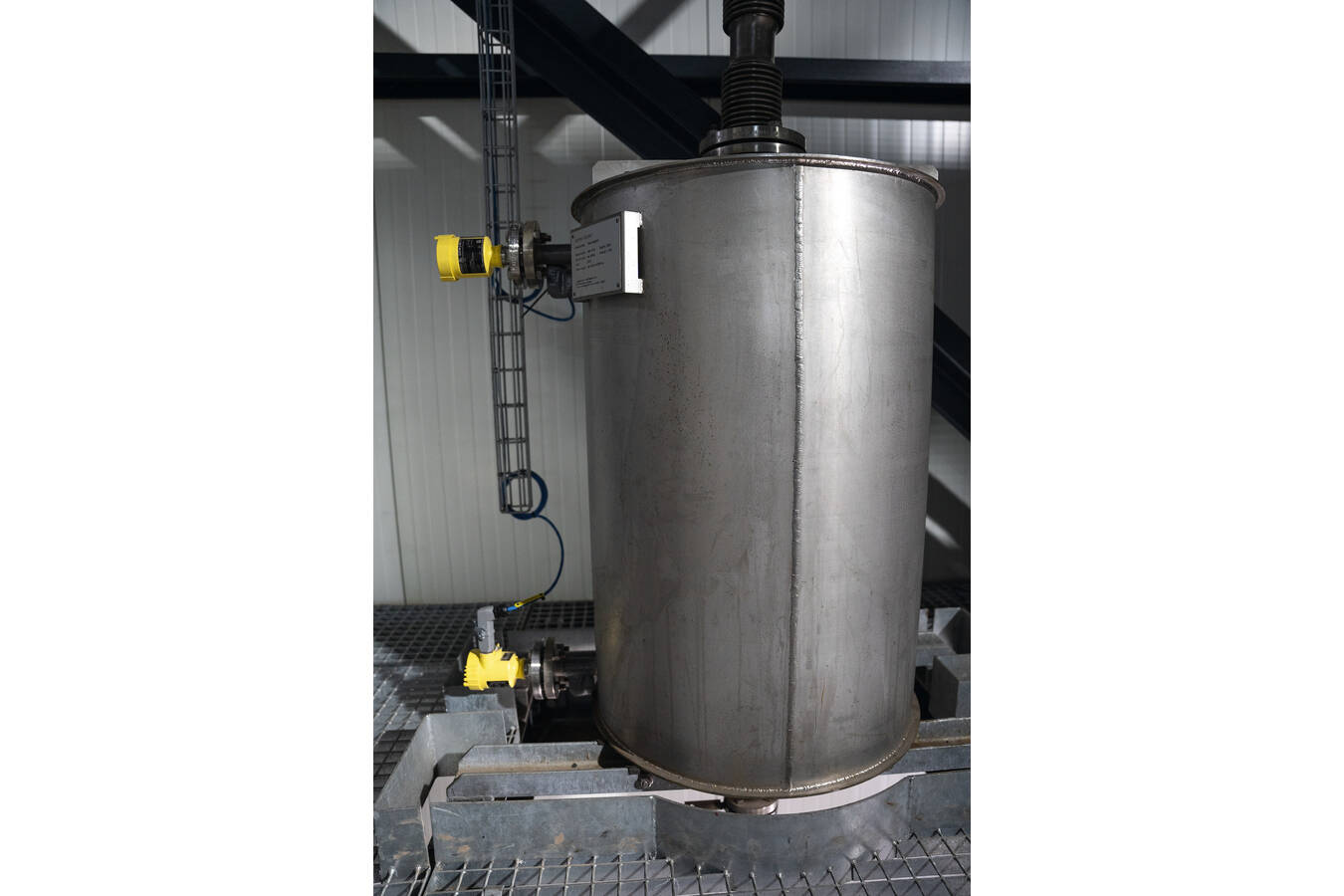
Maas is enthused about a solution that can read out multiple process variables at the same time with one measuring instrument. In addition to the total filling level, VEGA level sensors are also used to detect a possible separation layer i.e. interface between two different liquids. “Interface measurement is important for almost all of our containers. We can use it to monitor phase separation in the tanks and plan our maintenance operations better.” The data basis for this is to be provided by sensors already in use, via a second data channel. The Profibus PA communication standard commonly deployed in measurement technology will be utilised fully through 3 channels simultaneously. Meanwhile, the ICA team is already working on the next efficiency level: In the future, some previously necessary measurement points will be replaced by digital models using additional process and measuring point data. “The basic building blocks for this are reliable sensor technology as well as suitable communication and digitalisation concepts.”
Coveted particulate matter
At around 48 percent of total process output, pyrolysis coke, like pyrolysis oil, is a highly sought-after raw material. However, before it can be fed into other industrial processes, it must be cooled down in a controlled manner after leaving the reactor – from 550 °C to ambient temperature. Here, in the coke cooling area, VEGABAR 83 pressure sensors and VEGAFLEX 86 guided radar sensors continuously monitor the pressures and levels, thus ensuring constant utilisation of the cooling systems. The sensors are specially designed for harsh ambient conditions and high temperatures. Limit levels, often safety-relevant, are reliably monitored by VEGASWING 61, even in explosive atmospheres, before the pyrolysis coke is forwarded to the coke mill. Once there, it is ground ultra-fine and then pelletised into recovered carbon black. With its typical particle size of less than 10 µm, the powder can used as a base material for the production of new rubber, paints or coatings. Around 8.5 million tonnes of this fine bulk material are currently consumed worldwide every year just for tyres. The trend – and therefore the market price – is headed upwards. So it’s no wonder that PYRUM is delighted with the high proportion of carbon black – 48 percent, as mentioned above – the recycling output contains. The company literally has more customers than it can handle.
Making the world of tyres a little greener
Years of intensive research and tough battles now lie behind the PYRUM management and the approx. 70 employees in Dillingen. ICA engineers Christian Maas and Meike Jungmann also experienced this phase of the enterprise and are now focussing on the future. Now that the production facility has been successfully commissioned on an industrial scale, they are both certain that the effort was worth it. Larger orders, including from Greece and the Czech Republic, are in the pipeline, long-term purchase agreements for the raw materials produced have been concluded with major players in the chemical and tyre industries, and the company’s next plant is already in the planning stage. The real milestone, however, will be reached when all end products from the recycling process are 100 percent usable. PYRUM can claim to have opened up new markets for pyrolysis oil and carbon black – and made the tyre market a little, but a crucial bit, greener.