Overcoming Flow Obstructions in Industrial Hoppers
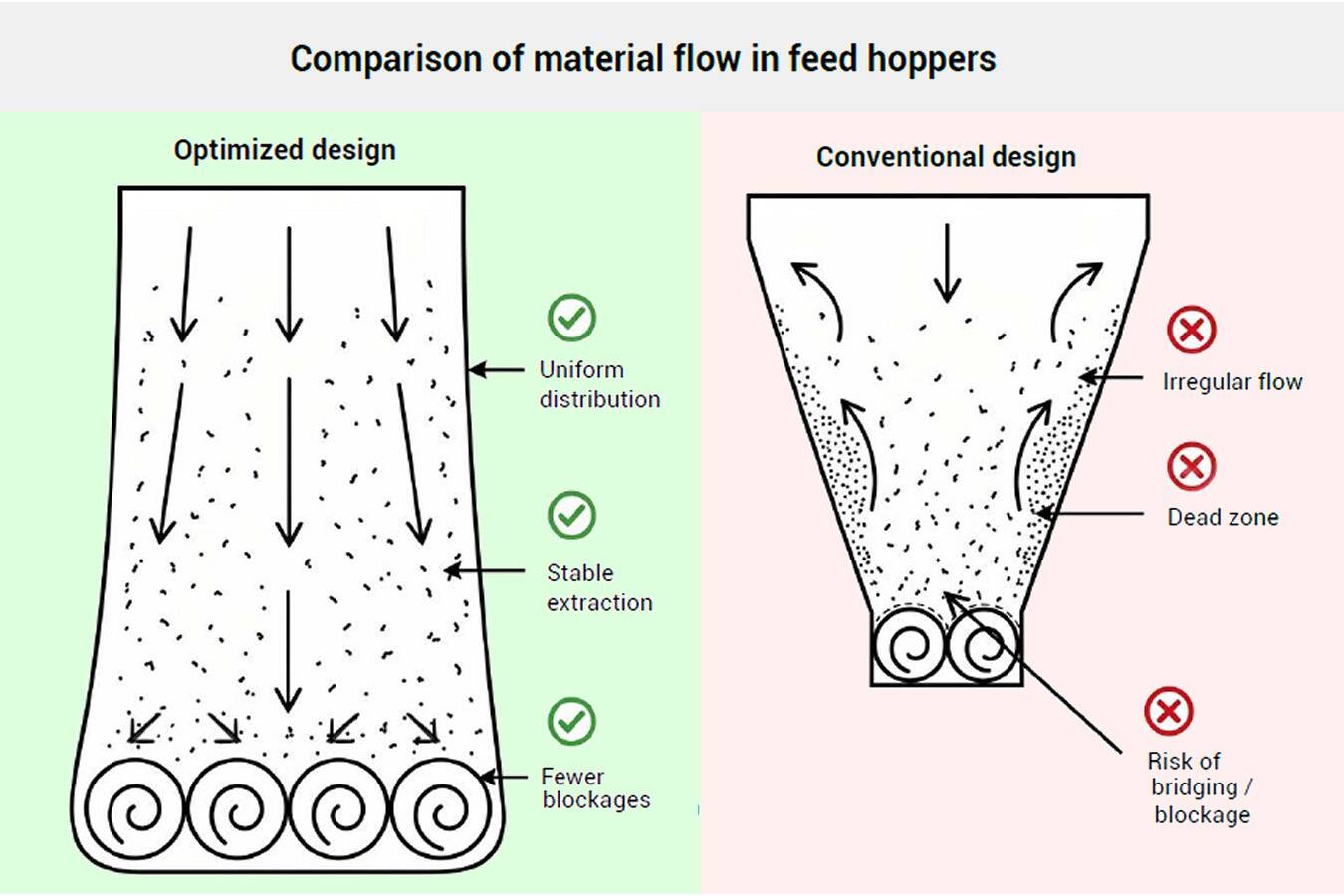
In the handling of bulk solids, traditional hopper geometries often lead to structural issues such as bridging or ”rat-holing.” These phenomena occur when material packs together above the discharge outlet, halting the production line and requiring manual intervention. By implementing an inverted hopper design, the physical pressure on the outlet is redistributed. This geometry prevents the formation of stable arches, allowing for a continuous feed into the screw conveyor system regardless of material cohesiveness.
The adoption of inverted hopper configurations provides several technical benefits for bulk material handling:
Key Advantages of Inverted Hopper Integration
- Reduction of material compaction at the conveyor inlet.
- Prevention of bridging and arching in cohesive powders.
- Enhanced volumetric efficiency for screw conveyors.
- Minimized downtime caused by flow interruptions.
- Improved safety by reducing the need for manual de-clogging.
Engineered Solutions for Complex Bulk Materials
Every bulk solid exhibits unique flow characteristics based on particle size, moisture content, and bulk density. Specialized engineering ensures that the transition between the storage vessel and the screw conveyor is optimized for the specific product being handled. By utilizing inverted walls and specific trough alignments, manufacturers can achieve a regulated discharge rate. This level of control is essential for dosing and weighing applications where precision and repeatability are critical for maintaining end-product quality.